Medicaid as Local Infrastructure: Enrollment, Financing, and Policy Exposure in Westchester and Rockland Counties
Authored by The Good Policy Institute
Expert Paper · August 2026
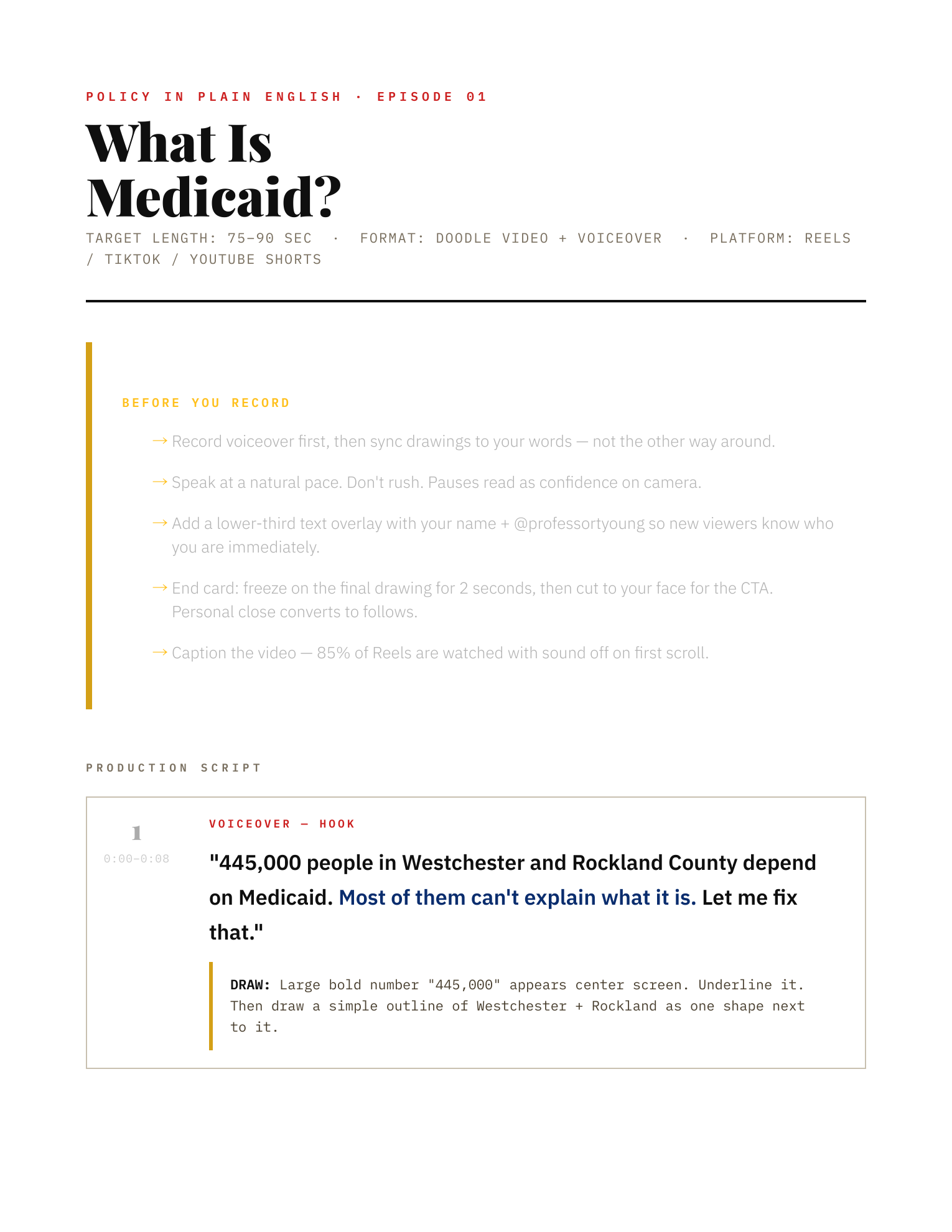
Abstract. Medicaid is often discussed as a distant public-benefit program, but county enrollment data show that it is a central element of health and economic infrastructure in the lower Hudson Valley. New York State reported 218,960 Medicaid enrollees in Westchester County and 150,116 in Rockland County in May 2026—369,076 people combined.1 This paper explains what that local reliance means, how Medicaid is financed, and why federal policy shifts can move risk to states, providers, families, and communities. It adapts the public-education premise of GPI’s Policy in Plain English Episode 1 script into a source-validated research brief.
Key Findings
| Finding | Why it matters locally |
|---|---|
| 369,076 people were enrolled in Medicaid across Westchester and Rockland Counties in May 2026.1 | Medicaid is a core coverage system for a substantial share of households across the two counties. |
| Medicaid is jointly financed by the federal government and states.2 | Changes in federal policy can affect New York’s fiscal choices, provider payments, and the administration of covered services. |
| Medicaid is the nation’s largest payer for mental-health services.3 | Coverage policy has implications beyond acute medical care, including behavioral-health access and continuity of care. |
| CBO estimated that the Medicaid provisions in Title IV of the House-passed H.R. 1 would increase the number of uninsured people by 7.8 million in 2034 relative to current-law baseline projections.4 | National budget choices can create local planning risk, even when a county-specific impact estimate is not yet available. |
Medicaid Is a Local System, Not an Abstraction
Medicaid is commonly described as insurance for people with low incomes. That shorthand is incomplete. In practice, it is a large-scale coverage and financing system that connects residents to healthcare services while supporting the payment structures on which providers rely. The program is jointly funded by the federal government and the states. The federal government contributes a specified share of eligible program expenditures through the Federal Medical Assistance Percentage, while each state must finance its own share under its Medicaid plan.2
For Westchester and Rockland Counties, the scale is concrete. New York State’s May 2026 county enrollment databook reports 218,960 enrollees in Westchester and 150,116 in Rockland, for a combined total of 369,076.1 These figures are administrative enrollment counts rather than a measure of service use, health status, or household need. Even so, they establish a clear point: Medicaid is embedded in the everyday health security of hundreds of thousands of people in the region.
Coverage Includes More Than a Doctor’s Visit
State Medicaid programs operate within federal requirements and may cover services through fee-for-service and managed-care arrangements.2 The policy significance extends beyond primary and hospital care. Medicaid is the single largest payer for mental-health services in the United States and plays a major role in financing substance-use-disorder services.3
This breadth is especially important when analyzing policy effects through an equity lens. Behavioral-health access, long-term services and supports, and care coordination often determine whether people can maintain stability at home, remain connected to work or school, and avoid preventable crises. A robust local analysis should therefore avoid reducing Medicaid to a single category of medical benefit. It is better understood as a network of coverage, providers, financing arrangements, and public systems that touch many stages of life.
Federal Policy Changes Can Reallocate Risk
Because Medicaid financing is shared across levels of government, federal policy changes can shift budgetary and administrative pressure to states. The Centers for Medicare & Medicaid Services explains that states are responsible for their share of expenditures under their state plans, even as the federal government contributes its designated percentage.2 This structure means that a reduction in federal support, a change in eligibility policy, or new administrative requirements can trigger decisions elsewhere in the system: state budgets, provider payment policy, enrollment operations, and local access to services.
The potential scale of federal changes is illustrated by the Congressional Budget Office’s June 2025 analysis of Medicaid provisions in Title IV of the House-passed H.R. 1. CBO estimated that those provisions would increase the number of people without health insurance by 7.8 million in 2034 relative to its current-law baseline.4 That is a national projection, not a county forecast, and it should not be converted into a Westchester or Rockland estimate without an appropriate methodology. Its local relevance is directional: communities with high Medicaid enrollment have a strong interest in how federal financing, eligibility, and administrative policy evolve.
Policy Implications for Westchester and Rockland
The local evidence supports three practical priorities. First, public institutions and community organizations should communicate Medicaid changes in plain language. Enrollment figures show the audience is not marginal; it is hundreds of thousands of local residents. Second, policymakers should evaluate proposed changes across the full coverage system, including behavioral health and continuity of care, rather than focusing only on headline budget figures. Third, local advocates should request transparent state-level impact assessments when federal changes are proposed, because the availability of county-specific enrollment data does not automatically reveal service, fiscal, or employment effects.
The Everyday Policy Project and THE HONEST SERIES offer one model for this work: connect policy mechanics to lived experience, distinguish verified evidence from advocacy claims, and make clear what information communities still need. Public understanding is not separate from policy capacity. It is part of the infrastructure that allows residents to participate in decisions that affect their care and their communities.
Method and Limitations
This paper combines a user-supplied GPI production script with publicly available New York State, federal, and congressional sources. The script shaped the paper’s explanatory focus but was not used as an evidentiary source for numerical claims. The paper uses New York State’s May 2026 enrollment figures for current county counts. It does not repeat the script’s unverified 445,000 regional enrollment figure, Rockland child-coverage percentage, facility counts, employment estimate, or a specific statewide spending-cut figure because those claims require additional primary-source validation before they can be presented as facts.
References
- New York State Department of Health. NYS Medicaid Enrollment Databook by Month: Enrollment by County, May 2026. Data updated June 4, 2026.
- Centers for Medicare & Medicaid Services. Financial Management.
- Centers for Medicare & Medicaid Services. Behavioral Health Services.
- Congressional Budget Office. Information Concerning Medicaid-Related Provisions in Title IV of H.R. 1, June 24, 2025.